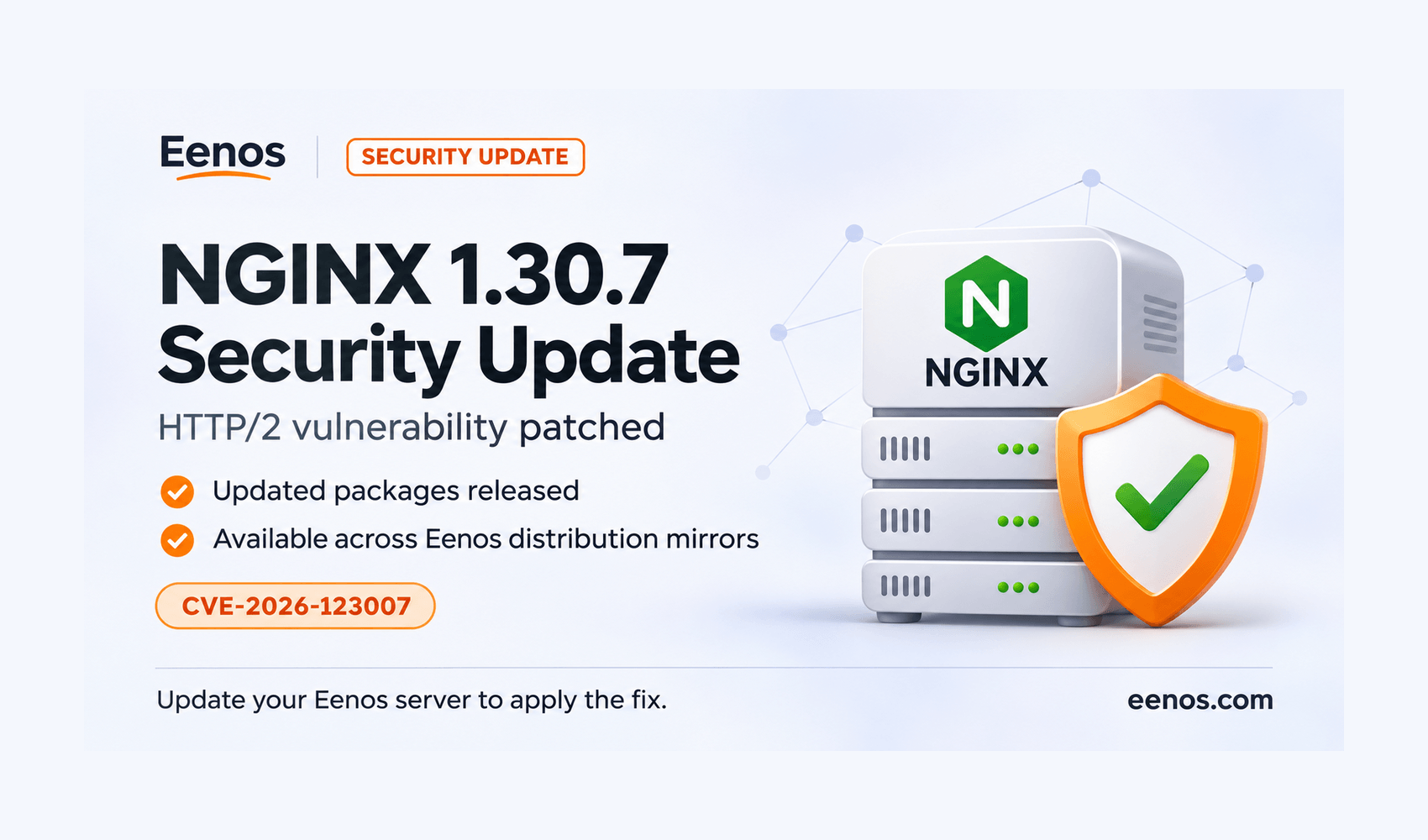
Critical NGINX HTTP/2 Vulnerabilities Fixed: Eenos Releases NGINX 1.30.7 Security Update
Published: November 19, 2026
Security vulnerabilities in widely used web server software can have far-reaching consequences, especially for hosting providers responsible for hundreds or thousands of websites.
On November 18, 2026, several security vulnerabilities were publicly disclosed in NGINX, including a serious HTTP/2 memory corruption issue tracked as CVE-2026-123007, also known as nginx2root.
The vulnerability has attracted considerable attention because it affects NGINX versions dating back more than a decade and may allow an unauthenticated attacker to execute code on a vulnerable server under certain conditions.
Eenos has already addressed these vulnerabilities by updating NGINX to version 1.30.7 and publishing the updated packages across all official Eenos distribution mirrors.
For hosting providers and server administrators using Eenos, the patched version is available through the normal package update process.
What Happened? Understanding the NGINX Security Vulnerabilities
NGINX is one of the world's most widely used web servers. It powers everything from small business websites and WordPress installations to high-traffic applications, reverse proxies, and hosting infrastructure.
Like any complex software, NGINX depends on careful handling of network connections, memory, and client requests.
The recently disclosed vulnerability, CVE-2026-123007, involves memory corruption in NGINX's HTTP/2 flow-control implementation.
HTTP/2 is designed to improve website performance by allowing multiple requests and responses to share a single network connection. While this makes web browsing more efficient, it also introduces additional complexity in how a server manages concurrent requests.
Researchers discovered that specially crafted HTTP/2 traffic could trigger a flaw in this processing.
Under vulnerable conditions, this may crash an NGINX worker process or potentially allow an attacker to execute arbitrary code.
What makes the issue especially concerning is that the attacker does not need a valid website login, hosting account, or administrative credentials to reach the vulnerable HTTP/2 functionality.
The vulnerability affects NGINX Open Source versions beginning with 1.9.5, released in September 2015.
NGINX released patched stable and mainline versions on November 18, 2026.
Why Is CVE-2026-123007 So Serious?
A typical web server faces the public internet continuously. Every incoming connection must be processed safely, regardless of whether the person making that connection is a legitimate visitor.
CVE-2026-123007 creates a risk at that network-facing layer.
Depending on the server configuration and exploit conditions, a successful attack may result in:
- An NGINX worker process crashing unexpectedly.
- Website or application availability being disrupted.
- Memory corruption within the affected worker process.
- Potential remote execution of malicious code using the permissions of the NGINX worker.
Remote code execution is particularly serious because it can provide an attacker with a foothold inside a server.
However, remote code execution in an NGINX worker does not automatically mean the attacker has root privileges. Gaining full administrative control would require additional conditions or another vulnerability.
Security researchers have demonstrated exploitation under laboratory conditions, which makes applying the available updates especially important.
Multiple NGINX Vulnerabilities Were Disclosed
Although CVE-2026-123007 has received the most attention, it was not the only security issue addressed in the latest NGINX release.
The November 18 security disclosures included vulnerabilities affecting several NGINX components.
| Vulnerability |
Affected Functionality |
| CVE-2026-123007 |
HTTP/2 flow-control memory corruption |
| CVE-2026-123633 |
HTTP/2 use-after-free |
| CVE-2026-123634 |
Resolver response processing |
| CVE-2026-121810 |
HTTP/3 use-after-free |
| CVE-2026-113425 |
Mail proxy use-after-free |
These vulnerabilities do not necessarily affect every NGINX server. Exposure depends on which features are enabled and how the server is configured.
Nevertheless, updating NGINX is the most reliable way to address the issues rather than relying on individual configuration workarounds.
NGINX 1.30.7 also contains fixes for additional security issues described in the official upstream changelog.
Eenos Has Released NGINX 1.30.7 Across All Distribution Mirrors
When a vulnerability affects foundational hosting software, getting the fix into users' hands matters just as much as identifying the problem.
Following the upstream security release, Eenos updated its NGINX packages to version 1.30.7 and published them across all official Eenos distribution mirrors.
This means users can obtain the patched NGINX version through their existing Eenos software repositories.
There is no need to manually download and compile NGINX from source or replace the web server with an unofficial build.
The update brings upstream security fixes to the NGINX version distributed by Eenos, helping hosting administrators maintain a more secure server environment.
What Does This Mean for Existing Eenos Installations?
If your server uses the NGINX packages supplied by Eenos, the security update is available from the official repositories.
Servers still running an older vulnerable NGINX build should be updated promptly.
Publishing the update makes the fix available, but it does not necessarily mean every server has installed it already. Administrators should confirm that their local installation has been upgraded and that the patched NGINX processes are running.
How to Check Your NGINX Version
You can verify your installed NGINX version from the command line.
On an updated installation, the expected version is:
bash
nginx version: nginx/1.30.7 (Eenos)
If your server reports an earlier version, check for available NGINX updates from your configured Eenos repositories.
You should also verify that the relevant NGINX service has been restarted after upgrading. This is important because replacing the package files on disk does not necessarily replace worker processes that are already running.
For Debian or Ubuntu-based systems, administrators can inspect available package updates using:
bash
apt update
apt list --upgradable
For RPM-based installations, available updates can be checked using the system's configured DNF repositories:
Install the NGINX update using your distribution's normal package-management procedure, followed by a service restart when appropriate.
Is Disabling HTTP/2 Enough to Protect a Server?
Temporarily disabling HTTP/2 may reduce exposure to the specific vulnerabilities affecting that protocol.
However, it is not a complete solution.
Other vulnerabilities addressed in the same NGINX security release affect features such as HTTP/3, resolver processing, and mail proxy functionality.
Disabling HTTP/2 therefore does not address every potential security issue in an outdated NGINX installation.
For Eenos administrators, the recommended action is straightforward: install the updated NGINX 1.30.7 packages rather than relying on temporary configuration changes.
Why Timely Web Server Updates Matter for Hosting Providers
For someone running a single personal website, a web server update might seem like another routine maintenance task.
For a hosting provider, the consequences of delaying security fixes can be much larger.
A single web server may handle traffic for dozens or hundreds of customer domains. If the underlying software contains a remotely accessible vulnerability, the potential exposure can extend across multiple hosted services.
This is why security maintenance is an essential part of operating reliable hosting infrastructure.
Keeping NGINX updated helps administrators reduce exposure to known vulnerabilities, maintain service stability, and protect customer workloads.
It also highlights the importance of using maintained software repositories.
Rather than tracking every upstream source release, compiling patches independently, and managing compatibility manually, administrators can install tested distribution packages through their normal update workflow.
Eenos and Web Hosting Security
Eenos is designed to help hosting providers and server administrators manage modern web hosting infrastructure through a centralized control panel.
Security maintenance is an important part of that environment.
By making NGINX 1.30.7 available across its distribution mirrors, Eenos gives administrators access to the latest upstream fixes for these newly disclosed vulnerabilities.
As with any security update, administrators should continue following sensible operational practices, including maintaining reliable backups, reviewing relevant server logs, restricting unnecessary network access, and keeping other server components updated.
No single update can eliminate every security risk, but applying timely fixes to internet-facing software is one of the most effective steps an administrator can take.
Final Thoughts: Update NGINX to 1.30.7
The discovery of a vulnerability that has existed in NGINX for more than ten years is a reminder that even mature, trusted software can contain security issues.
What matters now is making sure vulnerable installations receive the fixes.
NGINX 1.30.7 is available on all official Eenos distribution mirrors, addressing the newly disclosed HTTP/2 vulnerabilities and other upstream security issues.
If you manage hosting infrastructure with Eenos, check your NGINX installation, apply the available security update, and confirm that the patched service is running.
Keeping your web server current is a practical step toward protecting your websites, customers, and hosting environment.
Learn more about Eenos: https://eenos.com/
Official NGINX security advisories: https://nginx.org/en/security_advisories.html
NGINX upstream changelog: https://nginx.org/en/CHANGES
Frequently Asked Questions (FAQ)
What is the NGINX2Root vulnerability?
NGINX2Root is the name associated with CVE-2026-123007, a critical memory corruption vulnerability in NGINX HTTP/2 processing. Under certain conditions, an unauthenticated attacker may be able to execute code within a vulnerable NGINX worker process.
Which NGINX versions are affected by CVE-2026-123007?
NGINX Open Source versions 1.9.5 through 1.30.6 on the stable and older release branches, and mainline versions through 1.31.8, are affected. NGINX 1.30.7 and 1.31.9 contain the security fix.
Has Eenos fixed the NGINX HTTP/2 security vulnerability?
Yes. Eenos has updated its NGINX packages to version 1.30.7 and published the updated packages across all official Eenos distribution mirrors. Administrators should install the available update to protect their installations.
How do I update NGINX on an Eenos server?
Update the NGINX package through your server's configured Eenos software repositories using the normal APT or DNF package-management process. Restart the NGINX service as appropriate and verify the running version using nginx -v.
Does CVE-2026-123007 affect all NGINX servers?
The HTTP/2 vulnerability is relevant to affected NGINX versions when HTTP/2 is enabled. Other vulnerabilities disclosed in the same security release affect different features and configurations. Updating to a fixed release is recommended even when HTTP/2 is disabled.
Can the NGINX2Root vulnerability give attackers root access?
The NGINX HTTP/2 vulnerability may allow code execution with the permissions of an NGINX worker process. Obtaining root access requires additional exploitation or conditions. The vulnerability alone does not guarantee root-level access.
Is NGINX 1.30.7 available on all Eenos mirrors?
Yes. The NGINX 1.30.7 security update has been published to all official Eenos distribution mirrors, making it available through the existing Eenos package repositories.