PHP2Shell Security Fix: Eenos Releases Critical Security Patches for PHP 5.4 Through PHP 8.5
On October 21, 2026, the PHP development team disclosed two critical security vulnerabilities that sent an urgent warning to hosting providers, server administrators, and developers worldwide.
The vulnerabilities, CVE-2026-109618 and CVE-2026-109619, collectively known as PHP2Shell, could allow unauthenticated attackers to execute malicious code on vulnerable PHP installations.
For hosting providers managing hundreds or thousands of websites, vulnerabilities like these are particularly concerning. A single server may host applications running several PHP versions, including older versions that cannot easily be upgraded because of application compatibility requirements.
Within hours of the official PHP security release, Eenos began publishing updated PHP packages containing the upstream security fixes. But our work did not stop with the newer PHP releases.
Our development team also began the more challenging task of bringing these critical fixes to legacy PHP versions, extending our security patching efforts back to PHP 5.4.
We are pleased to confirm that Eenos has released security patches covering PHP 5.4 through PHP 8.5, including legacy PHP versions that are no longer maintained by the upstream PHP project.
Updated packages are available through the official Eenos repositories across our supported Linux distributions.
Understanding the Critical PHP2Shell Vulnerabilities
On October 21, 2026, the PHP Security Team released emergency updates addressing two critical vulnerabilities in the PHP runtime.
Both vulnerabilities received a CVSS v4.0 score of 9.2, indicating a serious security risk.
Unlike ordinary application-level vulnerabilities that may require a particular plugin, framework, or authentication mechanism, these issues affect PHP's underlying runtime behavior.
This makes them especially important for shared hosting providers, managed hosting services, and organizations operating PHP-based infrastructure.
CVE-2026-109618: Remote Code Execution Through Out-of-Memory Corruption
CVE-2026-109618 involves a flaw in PHP's handling of out-of-memory conditions.
Under certain circumstances, a memory allocation failure can interrupt request processing while internal data structures are only partially initialized.
When PHP attempts to clean up these structures, it may incorrectly process invalid memory, potentially creating an opportunity for remote code execution.
The vulnerability is particularly concerning because it involves internal request processing rather than a specific vulnerability in an application such as WordPress or another PHP-based platform.
CVE-2026-109619: Remote Code Execution Through Stale Global State
CVE-2026-109619 involves PHP retaining internal state that should have been cleared after memory was released.
In certain circumstances, a subsequent request handled by the same PHP worker may access this stale state.
Attackers may be able to exploit this behavior to compromise a vulnerable PHP process.
Both vulnerabilities have the potential to affect PHP installations serving web requests, including deployments using PHP-FPM, Apache modules, CGI, and LiteSpeed.
Installing updated PHP packages is the recommended solution. Configuration-based mitigations may reduce exposure to certain attack paths, but they do not provide complete protection.
Eenos Responded Within Hours of the PHP Security Release
Security maintenance is a critical responsibility for any hosting control panel.
When the PHP Security Team published the emergency updates on October 21, our immediate priority was to make the fixes available to Eenos customers as quickly as possible.
Our team began preparing updated packages using the security fixes provided by the upstream PHP developers.
The initial security builds focused on the newer PHP versions, with packages published to the Eenos mirrors within hours of the announcement.
This allowed Eenos servers to begin receiving updated PHP packages through their existing package management and automatic update mechanisms.
However, we recognized that the problem was not limited to newer PHP releases.
Many hosting environments still depend on older versions of PHP. These environments also needed attention.
Going Beyond Upstream Support: Security Patches for Legacy PHP 5.4–7.3
One of the biggest challenges following the PHP2Shell disclosure was protecting applications that still depend on end-of-life PHP versions.
The upstream PHP project no longer provides regular security maintenance for many older versions. Although the PHP Security Team provided special source-level backports for PHP 7.4, 8.0, and 8.1, older releases require additional vendor maintenance.
At Eenos, we know upgrading an older application isn't always straightforward.
A business may still be running a custom application developed years ago. An older content management system may require a specific PHP version. Some production systems depend on libraries or frameworks that are incompatible with modern PHP releases.
While upgrading remains the best long-term solution, these applications cannot always be migrated overnight.
That is why Eenos continues to maintain legacy PHP packages and backport relevant upstream security fixes into older PHP branches.
Following the October 21 security disclosure, our developers extended the patching work to PHP 5.4 through PHP 7.3.
This required more than simply rebuilding the original PHP source packages.
Older PHP branches have significantly different internal APIs, memory management behavior, and dependency requirements. Security fixes developed for modern PHP releases cannot always be applied directly to code written more than a decade ago.
Our team worked through these compatibility differences to incorporate the relevant security corrections into the legacy PHP packages.
The result is updated Eenos PHP packages covering the entire range from PHP 5.4 to PHP 8.5.
PHP Versions Covered by the Eenos Security Updates
The released security packages include:
- PHP 5.4, 5.5, and 5.6
- PHP 7.0, 7.1, 7.2, and 7.3
- PHP 7.4
- PHP 8.0 and 8.1
- PHP 8.2, 8.3, 8.4, and 8.5
This gives Eenos customers access to updated PHP packages across both modern and legacy application environments.
Important: Security backports for older PHP versions do not restore official upstream support or guarantee that those versions are free from other vulnerabilities. We strongly recommend migrating to an actively supported PHP version whenever possible.
Security Packages Available Across All Supported Linux Distributions
The PHP security updates have been prepared and published for all operating systems currently supported by Eenos.
These include:
- Debian 13
- Ubuntu Server 22.04 LTS
- Ubuntu Server 24.04 LTS
- Red Hat Enterprise Linux (RHEL) 9
- AlmaLinux 9
- Rocky Linux 9
- CloudLinux 9
All packages are available for supported 64-bit systems through the official Eenos package repositories.
Maintaining PHP packages across multiple distributions is an important part of our commitment to hosting providers who need flexibility in choosing their server operating systems.
Whether you are running an Ubuntu-based hosting environment, an enterprise RHEL deployment, or CloudLinux for shared hosting, the updated PHP packages are available through the Eenos software repositories.
How to Update PHP on Eenos Servers
Keeping PHP up to date is one of the most important steps you can take to protect websites and hosted applications from known security vulnerabilities.
Eenos provides an automatic update mechanism that makes this process easier for server administrators.
Servers With Automatic Updates Enabled
If automatic updates are enabled on your Eenos server, the updated PHP packages will be installed during the next scheduled update cycle.
You don't need to manually download packages from an external source.
However, because these vulnerabilities are critical, administrators should verify that the updates have completed successfully rather than assuming that every server has already been patched.
Servers With Automatic Updates Disabled
If you have disabled automatic updates, we recommend updating your Eenos PHP packages as soon as possible.
Administrators should also check that the relevant PHP services are running the updated binaries after installation.
Where necessary, restart or reload the affected services and verify that the patched PHP version is active.
If you manage multiple servers, prioritize internet-facing production systems and any installations still running older PHP versions.
Why Legacy PHP Security Maintenance Still Matters
End-of-life PHP versions remain a challenge throughout the hosting industry.
Although PHP developers strongly encourage upgrading to modern releases, many organizations continue to operate applications that were developed around PHP 5.x or PHP 7.x.
In an ideal environment, every application would always run on the latest supported PHP version. In practice, hosting providers often need to maintain compatibility while customers modernize their software.
This creates a difficult balance between application availability and security.
At Eenos, our approach is to support that transition by maintaining legacy PHP packages and incorporating relevant security fixes where technically feasible.
We believe hosting providers should have a practical path to keeping older environments maintained while planning their migration to modern PHP.
That does not mean older PHP versions are as secure as current releases. Their age, dependencies, and lack of regular upstream maintenance still present significant risks.
Legacy PHP security patches should be viewed as an additional layer of protection, not a permanent replacement for application modernization.
Why PHP2Shell Requires Immediate Attention
The October 21 PHP security disclosure is a reminder that vulnerabilities can exist below the application layer.
Even a carefully maintained website may be exposed if its underlying PHP runtime contains a critical security flaw.
The risk is not limited to any particular content management system or PHP framework.
According to the official PHP advisory, affected web-serving configurations include:
- PHP-FPM
- Apache with mod_php
- PHP-CGI
- LiteSpeed PHP
- Other PHP-based web-serving runtimes
The PHP Security Team has made it clear that updating is the only complete solution.
For server administrators and hosting providers, the priority should be to install the patched PHP packages, verify that the updated runtime is active, and investigate any signs of suspicious activity.
Our Commitment to PHP Security and Long-Term Compatibility
The Eenos development team has been working to provide a hosting control panel that combines modern infrastructure management with the practical needs of hosting providers.
Supporting multiple PHP versions has always been an important part of that mission.
The PHP2Shell security disclosure demonstrates why ongoing package maintenance matters.
Within hours of the initial announcement, we began making security updates available for current PHP releases. We then extended the patching process to older PHP branches, including versions dating back to PHP 5.4.
This work reflects our commitment to helping hosting providers maintain reliable infrastructure, even when their customers depend on older application environments.
We will continue monitoring upstream PHP security announcements and maintaining the Eenos PHP package repositories.
For customers, our recommendation remains simple: keep automatic updates enabled, verify that critical security updates are installed, and upgrade older PHP applications whenever possible.
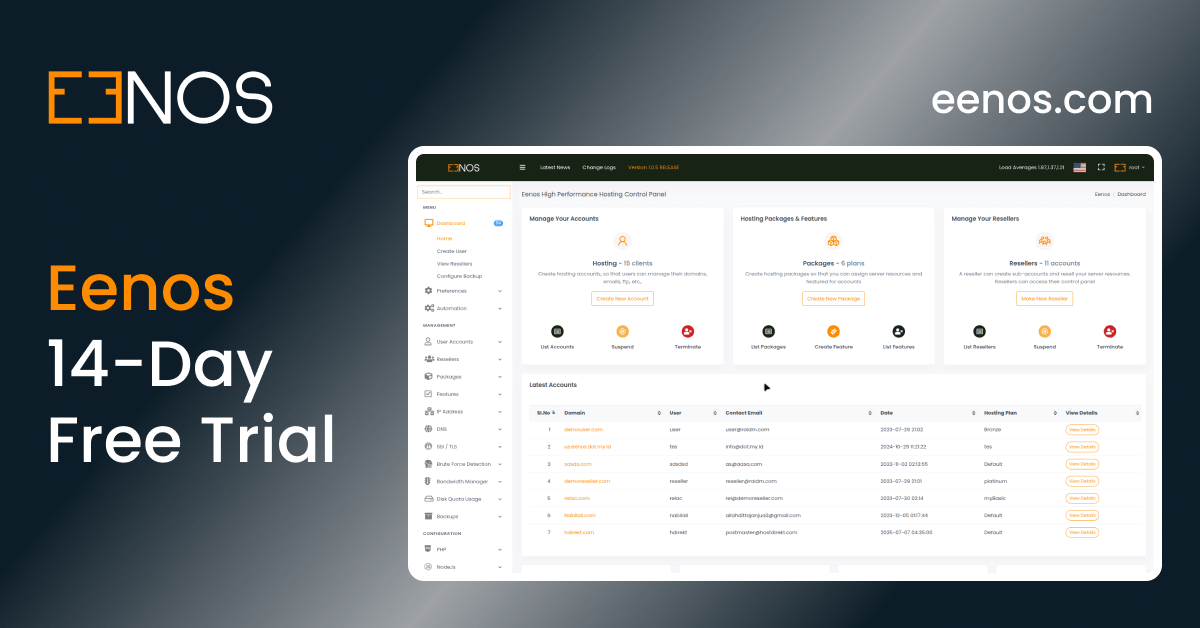
See Eenos Multi-PHP Management in Action
Want to see how Eenos manages multiple PHP versions? Explore our live demos and discover how easily you can install, configure, and manage PHP versions for different websites.
Eenos supports PHP 5.4 through PHP 8.5, allowing modern and legacy PHP applications to run on the same hosting server. Administrators can manage available PHP versions and server-wide configurations, while website owners can select their preferred PHP version and customize PHP settings through the User Control Panel.
Explore Multi-PHP Management:
Experience how Eenos simplifies Multi-PHP hosting, giving administrators greater control while making PHP management easier for website owners.
Frequently Asked Questions
What is the PHP2Shell vulnerability?
PHP2Shell refers to two critical PHP security vulnerabilities disclosed on October 21, 2026: CVE-2026-109618 and CVE-2026-109619. Both can potentially allow unauthenticated remote code execution on vulnerable PHP installations.
Which PHP versions are affected by the October 2026 security vulnerabilities?
The vulnerabilities affect multiple PHP versions, including older legacy branches. The PHP project released security updates for PHP 8.2 through PHP 8.5 and special source-level backports for PHP 7.4, 8.0, and 8.1. Additional legacy releases require vendor-provided patches or upgrades.
Does Eenos provide PHP2Shell patches for PHP 5.4 and PHP 5.5?
Yes. Eenos has extended the relevant security backports to PHP 5.4 and PHP 5.5 as part of its legacy PHP maintenance effort. Updated packages are available through the Eenos repositories.
Are PHP 5.6 and PHP 7.0–7.3 also patched?
Yes. Eenos has prepared updated security packages covering PHP 5.6 and PHP 7.0 through PHP 7.3, alongside newer PHP releases.
Are the PHP2Shell security fixes available for Ubuntu and Debian?
Yes. Eenos PHP security packages are available for Ubuntu Server 22.04 LTS, Ubuntu Server 24.04 LTS, and Debian 13.
Does Eenos support these PHP security updates on AlmaLinux, Rocky Linux, RHEL, and CloudLinux?
Yes. The updated PHP packages are also available for AlmaLinux 9, Rocky Linux 9, Red Hat Enterprise Linux 9, and CloudLinux 9.
Will Eenos automatically install the PHP security patches?
Servers with Eenos automatic updates enabled will receive the packages during their next scheduled update cycle. Administrators should verify successful installation, particularly on production systems.
Is PHP 5.4 safe to use after installing the security patch?
The Eenos update addresses the relevant PHP2Shell vulnerabilities, but PHP 5.4 remains an end-of-life version with other potential security and compatibility risks. Migrating to a supported PHP version is strongly recommended.
Do these PHP vulnerabilities affect LiteSpeed and PHP-FPM?
Yes. The official PHP advisory identifies both PHP-FPM and LiteSpeed among the affected PHP web-serving configurations. Installing the patched PHP runtime is necessary regardless of the web server being used.
Where can I find the official PHP security advisory?
The original advisory was published by the PHP development team on October 21, 2026:
https://www.php.net/archive/2026.php#2026-10-21-5
About Eenos
Eenos is a Linux hosting control panel designed for hosting providers, server administrators, and developers. It offers tools for managing websites, email, DNS, databases, PHP environments, security, and server infrastructure through modern administration interfaces.